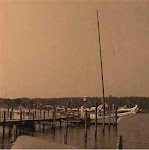
In the last quarter of the 20th century St. Mary’s County Maryland still had outhouses, tobacco farms, fishing villages and plantations. One of the last live radio stations in America carried the only available daily news. There were a couple of traffic signals, a couple of dress shops, small community grocery stores and a Navy base that most military personnel considered a hardship posting.

Still, just as the first English settlers had determined 350 years before, there were always some who saw the remote and marshy peninsulas for what it is: a marketable paradise.


Showing posts with label Jackie Russell. Show all posts

Sunday, August 26, 2012

2000 Square Feet of Sail Rigged to the Dee of St. Mary's


When the Dee of St. Mary’s set out for the 1981 oyster season, her first working season, she carried 2,800 square feet of sail, roughly 2,000 square feet in her mainsail and the remaining in her jib.
 The vast surface of sail is for strength, not speed. A good sailing day’s work had the Dee dragging steel cages attached with steel elevator cable  running off both sides of the boat. The dredges’  maws were lined with chisels for teeth, each dredge able to hold a hefty sailor. 
"If you didn't have enough wind you threw out one to the windward," Jackie Russell said of the decade he oystered from the Dee.
Below Cedar Point, at Little Cove Point off the Chesapeake Ranch Estates, trying to get home to St. George Island, a “flaw” caught the Dee full sail and she heeled over. “Water was five or six feet up the deck,” Jackie  recalls.  “When she spilled her wind she popped right back up. Needless to say I had already spilled my wind back at the wheel.”
Flaws, erratic and unexpected gusts of wind, are prevalent along the Calvert County Chesapeake Bay shore cliffs, from Solomons Island northward.
“It was a sail day,” Jackie said of the day the Dee ultimately spilled her wind. “We were drujin’ down the shore. We had a conveyor chain on a clam rig off the bow. Hung it down right at the water line. We had it to break ice. It helped save the wood. In the morning, going out of the harbor, you’d go to the crick. The goddamn crick was froze up half the time, because we had winters at one time. No one would break you out. You had to do it yourself.”
In 1988, the U.S. Coast Guard certified the Dee as seaworthy to carry passengers with a double-reef proviso.  Reefing is the processes of lowering the sail to reduce its surface.
Reef points are lines of grommets that run horizontal from the boom on triangular sails. They are threaded through with short, secure lines. The Dee has four rows of reef points. The line threaded through each falls 18 inches from both sides of the grommet. To double reef her, the second row of reef points from the bottom are tied to the lacing holding the sail to the boom. The sail is considered double-reefed.
The sail is made of a stiff, laminate synthetic which in a 2,000 square foot chunk is heavy. Really heavy. Members of the Seafarer’s International Union attending classes at the Harry Lundeberg School of Seamanship at the Paul Hall Center in Piney Point, Maryland helped put the sail back on in early July 2012.

Sunday, April 1, 2012

Launching the Skipjack


 November 1979 -- recalled in 2009

“We had about 3,000 head down here that day.”
Jackie Russell’s face lights up still today, remembering that day in 1979. He’ll draw himself from the peace of sleep, from even the fury of interruption and turn immediately back to that most exhilarating of days nearly half his lifetime ago.

“ ‘National Geographic’ was there, but the fella who’d followed it couldn’t be there that day and the pictures got rejected and that was why we never got in ‘National Geographic’ magazine.
“All the politicians were there, big hoop-de-la for Piney Point. And of course after they couldn’t get the boat off everybody went up to Swann’s and got smothered drunk. Except me. I slept on the boat that night.”

A roughly treated, large color photograph of that day is perhaps one of those rejected. I found it at the bottom of one of the drawers of Dee memorabilia in the trailer’s closet-bedroom. I can't find it anymore. It must have been shot during the smothering. Jackie Russell is alone on the stern of his new boat, looking down at her V bottom wedged in the muck of a low tide. Aground. He is centered in the heart of the photo, small aboard his big boat. A cap pulled hard over his head. An arm checkered in a woolen jacket dangling from the rail. He does not see the photographer.

You want to think it is a funny picture, but of course it isn’t. But it isn’t foolish or pitiful either. The most appropriate caption would seem to be, “What is wrong with this picture?”


“It floated off,” Jackie Russell continues. “It was three days later. We got a high tide, a sou’ easter’ and a high tide. It was lightly snowing and the fellow who was married to Anita Evans, I can’t remember his name. Doug. He was at the school and got a wet suit and cut the chains loose and pulled them loose from the fifth wheel and the boat floated off. We got her off December 19th and it was lightly snowing. I think we tried to launch it the 16th and we couldn’t get it off.

The deal was, I think the deal was, the wheels were all in a line.” He sits up in bed, staring into middle space, seeing the scene yet again. “Really why we couldn’t launch that boat, all the wheels were in a line and there was an old boat ramp there at Swann’s and somebody had been digging some manoses out of that boat ramp, that concrete boat ramp. And as those wheels went off the boat ramp one behind another she bogged down right at the end of that ramp. And it might have even been an old piece of concrete at the end of that ramp got caught up.

“And the tug boat the Susan Collins couldn’t pull her off. They had the tug boat up at Lundeberg School and the tug boat couldn’t even pull her off into the river.”

He falls backs and shuts his eyes. "Enough," he says. "Go on to another chapter."

It was more than 25 years ago I had the first of what sometimes feels a lifetime of ridiculous interviews with Jackie Russell. This night, when he tells again of that day, towel abandoned on the floor, dirty clothes resting on top of clean, it doesn't feel particularly different.
Back then I hadn’t any idea what his business was about. I mean his professional business. I did, finally, notice his eyes.

Almost every woman I met those early years, if Jackie Russell dropped into the conversation the next sentence had to do with his eyes. They possessed the cinematic trick that forced a comic book twinkle out of Tony Curtis’ blue eyes in one of the celebrity vehicle movies of the 1960s. The leitmotif gag played for the duration of the movie whenever Tony Curtis’ character’s blue eyes met the camera.


Jackie could do it, can do it, without the cinematic assist, without the gag. “Jackie is genuine,” one of my least demonstrative girlfriends once gushed in a moment of appreciation. I grunted. Somehow I still suspect something of the trick to it. I can see the glint looking as far back as that first interview when he opened his arm wide to introduce his Associates. “My associates,” Jackie Russell welcomed me aboard his skipjack with a majestic sweep of his arm gesturing up the forward deck, just then being swabbed clear of the last of the oyster debris of the day.

A half-dozen men, layered in rag-tag collections of shirts and jackets and rubber boots to their knees, glanced up from their task and acknowledged me with sudden grins, then looked quickly to the captain before returning to their tasks or sauntering off.

“I call them my associates,” Jackie Russell confided to me, walking me aft. “It sounds better that way.”

Jack Russell was an egalitarian captain, well, as egalitarian as a captain can become. A huge snort of laughter bursts from him today as he reads over my shoulder.

“I can’t remember the name of the one who worked with Tynan Poe’s son, who, the two of them, beat up Eddie Poe so bad that time,” Jackie laughs. “He told me they were doing all the work and I was making all the money. He laughed.
He welcomed me aboard the skipjack, that first time, with his wide open arm, such a smooth gesture that it goes unnoticed once his eyes get you.
He draws that inclusive arm back, his left arm, and then brings it forward to grasp your forearm in a near embrace, then suddenly blocking that embrace he swings his right hand around and reaches for yours and grabs that handshake to pull you in closer. He holds you face to face, and he’s just a little bit too close but he stays too close, shaking your hand, close and tight. Without quite knowing how, you’re too close for refusal, too off-balance to step back.
Before you know it, you’re aboard, you’re a pirate too, you’re in his world and pleased with yourself. You’re possibly even lost to yourself.

Sad Story

Somewhere there is a black and white photograph of Jackie Russell taken the first day I met him. In this old black and white photo self-consciousness shows in his eyes which are averted from the photographer. Otherwise it is an unusual photo of him. He wears a sports coat, no hat and holds a pencil with its eraser touching the perfect bow of not quite pursed lips.

For a newspaper, the description of a photograph is in the present tense. The cutline sustains the action. Even if the photograph is centuries old, its description is of its current depiction, even if that which it depicts no longer exists today.
It is perhaps merely this that makes old photographs seem poignant. Makes us keep them. Makes them worth a thousand words.

“His is a sad story,” Joseph Norris intoned the day that photo was taken. We sat side-by-side in cold metal folding chairs. He looked up at Jackie Russell. First time I’d seen Jackie Russell. Joseph Norris hung his head. His arms draped over his thighs and he looked at the lean reporter’s notebook held in one and a pen held in the other of his dangling hands. “A very sad story,” he repeated and slowly shook his head.
Joseph Norris is an authority on local sadness. He sings woeful ballads of the disappearing Chesapeake culture and munificence. He writes prodigiously of St. Mary’s County’s losses. He calls it The County. He carries about himself a moroseness and appreciation thereof. At barely 30, he was a tradition, under his belt a decade in local print on the subject of all that was gone or headed that way. That morning at 4 a.m. he showed me how to work the audio switches in the closet where he broadcast the news. And where, on Monday, I would broadcast the news.
“It’s good on Wednesdays,” he told me when the closing bars of the “He IS Southern Maryland News” promo played and he opened the door, unfolded himself from the closet and joined me in the hall. Wednesday was the day The Enterprise published so the local stories were fresh. “But you’ll have some good local stories for Monday,” he assured me. We were to meet up again at 8 a.m. for the Potomac River Fisheries Commission meeting held in Colonial Beach, Va., a two-hour drive but right across the river as the radio beams fly. “Probably the most important story you’ll face,” Joseph Norris told me.

I located Joe in the first row. Sliding into a seat next to him I jumped when my skirt slid up and my thigh made contact with the cold metal folding chair. I realized I was the only woman in the room. At the far wall a bank of white men faced the room. They sat across the width of three tables pushed together end-to-end. Behind them, sitting off to the side next to the wall, I spotted one other woman. She was also taking notes.
Behind us sat 40 or 50 men, mostly with their hats in their hands but a few with caps affixed atop their heads that they’d methodically take off, punch or fold about a bit with their hands and replace. They wore mostly old clothes, outdoor clothes, long-sleeved shirts and heavy woolen vests. Some held thick coats in their arms wrapped tightly around their chests. They were brightly clothed above their underpinnings of gray and brown and scuffed workpants, creased and greased. Their shirts and coats and hats filled the room with tufts of bright red, faded hunter green and flecks of yellow-gold.
I wouldn’t have noticed that day, but there would have been no blue. No blue beyond faded denim. A bad luck color aboard a boat, blue is. As bad of luck as carrying a women aboard I have had occasion to learn since.

The watermen were all a sad story, Joseph Norris had told me before we left The County. Their way of life was disappearing. The oysters were dying. None of the fish populations were what they used to be.
“Who’s that?” I asked Joe, squirming to warm the seat.
“Jackie Russell. He’s one of the saddest stories yet.”
He didn’t look all that sad to me. He looked, actually, to be in pretty good shape. Jackie Russell had the round face of a little boy with a couple broken blood vessels to enhance rosy cheeks. A small curl actually did curl down the middle of his forehead. He had lips like a bow when he pursed them together in a pose of attention. I mention this only because of the photo mentioned above. Because, actually, usually he was grinning.
He had a quick smile and bestowed it widely, speaking to nearly everyone in the room. He moved smoothly through the rows of chairs, suddenly up from his seat at the front table to grab a man’s upper arm and clasp his hand in a pumping shake, then startling me only a row away, pulling another man near to whisper something short before leaning back with a guffaw. Straight, white teeth. He’d throw his head back when he laughed. He’d reappear behind the table, his arm around yet another man. Shaking hands. All the while smiling, laughing.
“He doesn’t look sad,” I said to Joe.
“He’s from The County,” Joe said in a mournful tone. “He’s local,” Joseph Norris said of Jackie Russell.
“Oh yeah?” I said. “Local, like St. Mary’s County?”
“Oh yeah. More than that. St. George Island. He built a skipjack.”
“Uh, huh,” I said, looking finally from Jackie Russell and registering a blank look for Joe Norris.
“A skipjack,” Norris said, lifting his arms up from their dangle in a struggle to convey to me the colossal nature of such a thing. “First one built in half a century. The Dee of St. Mary’s. A boat. A big boat. A big working boat. A wooden sailing boat.”
Joseph Norris was upright in his sea. “She’s the youngest vessel of the last commercial sailing fleet of North America.”
“Uh, huh,” I said, looking back at Jackie Russell, who was still not looking back at me.
It’s even possible Joe Norris told me the whole skipjack story that day, that first day I saw Jackie Russell. But I don’t remember Joe telling me the story of the skipjack. I only remember Jackie Russell telling that story.


I didn’t get the story that day. I couldn’t even pull that glad-handing man’s eyes to mine that day. That day I was too far away to get the story. To get that story. But I got the drift, which was more than Jackie Russell got as I tried again and again to catch his icy blue eyes and suspected for the first and not for the last time that he might be pointing them steadfastly away from me. “Well,” I said, determined, not for the last time, to not take it personally, “he doesn’t look sad at all to me.”
“But it is a sad story,” Joseph Norris insisted with his hanging, shaking head. “He built this beautiful boat and then him and his wife split up.”
“Well,” my head jerked up and I tried yet one more shot at those icy eyes. “Well break my heart.”